
The Word Weaver
In this section, I look at popular romance novels. I revel in and reveal the genius of the writing. Essentially, I will be giving a book review from a writer’s perspective.
Updated 10/22/26 By Chey Motes
English teacher by day, romance writer by night. Welcome to class, where Ms. Motes analyzes the power in popular romance novels, connects stuffy English Literature mechanics to romance writing, and documents her own journey into Authordom.
I always thought that to be a great writer, I needed to analyze great writing. Then, under the covers with flashlight beaming, I would indulge in a romance or two. For years, between after school extra curricular activities and high school finals, then from college lectures and odd jobs to make some text books and tuition scratch, I would read romance novels.
It was not classic literature nor anything from The New York Time’s Bestseller or the nationally accredited best book that lay on my night stand. At some point, reading literature during the day and reading popular romances at night had me seeing Binocular Vision. I had to look this term up, but the visual is when one eye sees an image and the other eyes sees another, then both eyes blend images together to make a third dimensional image. Essentially, I began to see romance in text books and literary craft in romance novels. The art of language was transferrable between literatures’ best works and romance’s popular novels. I couldn’t see the difference, but those around me could.
If you are a teacher or student, you are expected to read the best of the best as deemed by some literary guild of judges or underground obscure foreign literature connoisseurs. You tell a professor that you finished East of Eden, they lift an eyebrow of approval. You tell people you're an English major and they tend to ask your favorite book. The brow people raise is not as kind when I say The Deal by Elle Kennedy, the King Series by T. M. Frasier, or anything by Kristen Ashley. Even a professor might cough in surprise and politely nod their head. Unless the romance novel is a classic like Wuthering Heights or Sense and Sensibility, most romance readers would keep the book titles to themselves, unless they were sharing with anonymous strangers on a site of fellow romance lovers.
How is the most rapidly produced, published, and consumed genre treated like a dirty secret?
Well, when society tends to trash talk and bad mouth romance as “porn” or “sensationalism” without any decorum, of course we would keep our romance titles gripped closely to our chests. Why would we explain that in their time even Jane Austen and Emily Bronte could have been seen as sensationalists. Why is it that unless a novel survives the test of time, is a controversial piece or an obscure writing of some unknown author (popular by not being popular) that romance novels are deemed unworthy of mention as “good writing”.
The frustration of keeping my love of romance novels a secret led to keeping my Romantic imaginings a secret too. Notebooks fill my bookshelves alongside the jars and cups filled with my collection of pens, cute and blank journals, and books on various topics used to fuel my details. Notebooks full of romantic musings, titillating dialogue, and drool worthy scenarios. During the day, I write analysis papers on the classics in a formal language that is only ever used in the classroom or in a newspaper and textbook. At night, I turn my pen to a different craft of writing, expressing the voice that constantly stream in my head, but keeping my dreams inside my head where they belong.
But not anymore.

Educator’s
Ink

Essentially, this section is the lesson plan of the blog. In this section I address the academic aspects of writing with the academic terms for the above writer’s effects on the reader.
Motif - a common pattern found in a work of writing.
In this blog we will look at the patterns of a writer and the effects they have on their reader. Even romance writers use craft.
I see tiny pieces of craftsmanship in writing, like a mote in a piece of fabric. A speck left in the natural weaving of the yarn to make fabric, which is both unique and distinct. To apply this analogy to writing, each writer shows specks of unique skill, and as a teacher of English Language Arts, I hope to train your eye to the motes found in popular romance writing.
This section is an authentic diary with reflective observations of how I develop my own novel. A beginners beginning into authorship and self-publishing.
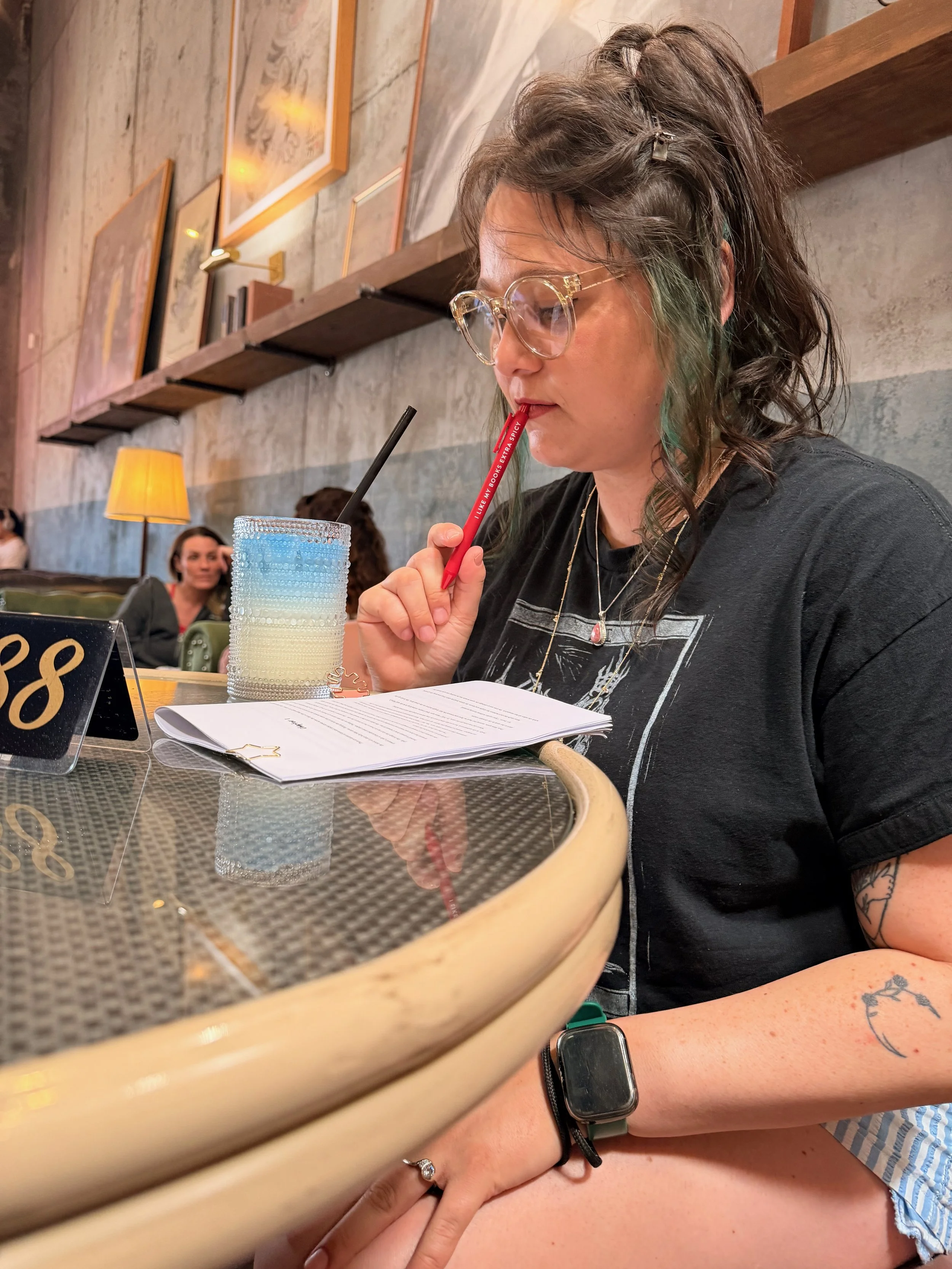
The
Draft Diary
10/22/26
Today marks the first blog post. As a romantic who writes in the romance genre, I deemed it fitting to publish my first blog post on the anniversary of my epic romance.
Woah, blogging is actually pretty tough, because of the advertising and making content that interests others. We’ll see if I can make my own novel as interesting to readers.